Early-universe cosmology
Geodesic congruences and anisotropic shear in a Bianchi type I universe.
KASI & UST · 2014 – 2015 · with Prof Seok Jae Park, and with Prof Yong Seung Cho of Ewha Womans University
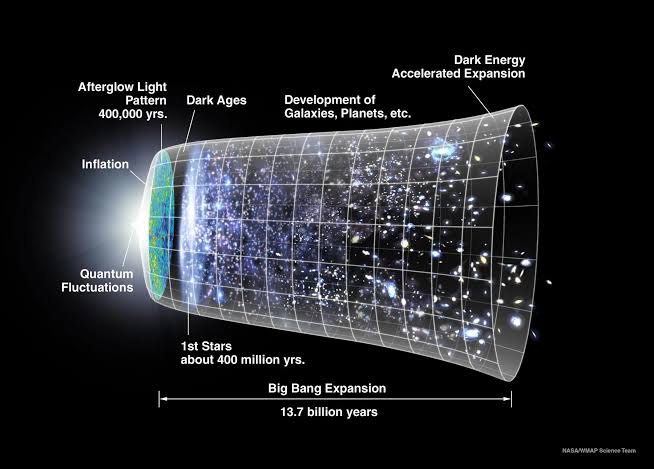
Cosmology assumes the universe is homogeneous and isotropic, and the assumption works extremely well. But it is a statement about the universe we observe now, not about the one that began: nothing in general relativity requires the initial state to have been isotropic, and inflation is credited with erasing the anisotropy rather than with its never having existed. From 2014 to 2015, the question I worked on as a teenage graduate researcher - the first PhD course that I did, in KASI & UST in Korea (2009-2018) - is what that erasure looks like written down, and whether anything survives it.
The setting. The simplest homogeneous but anisotropic model is Bianchi type I, which expands at a different rate along each axis:
\[ds^{2} = -dt^{2} + X^{2}(t)\,dx^{2} + Y^{2}(t)\,dy^{2} + Z^{2}(t)\,dz^{2}, \qquad l^{3} \equiv XYZ\]Setting \(X = Y = Z\) recovers Friedmann–Robertson–Walker, so the anisotropy is a genuine generalisation rather than a different theory. The vacuum case is the Kasner universe.
The kinematics. For a timelike geodesic congruence with tangent \(\xi^{a}\), the gradient \(B_{ab} = \nabla_{b}\xi_{a}\) decomposes into an expansion, a shear and a rotation:
\[B_{ab} = \tfrac{1}{3}\theta\, h_{ab} + \sigma_{ab} + \omega_{ab}, \qquad h_{ab} = g_{ab} + \xi_{a}\xi_{b}\]Bianchi I initial conditions make the rotation negligible, so \(\omega_{ab} = 0\) and the dynamics live entirely in \(\theta\) and \(\sigma_{ab}\).
The evolution equations. Contracting the Riemann identity for \(B_{ab}\) gives a Raychaudhuri-type equation for the expansion, which in this geometry can be written purely in terms of the mean scale factor \(l\) and the shear amplitude \(\Sigma\):
\[\dot{\theta} = -\tfrac{1}{3}\theta^{2} - \sigma_{ab}\sigma^{ab} - R_{ab}\xi^{a}\xi^{b} = -\frac{3\dot{l}^{2}}{l^{2}} - \frac{2\Sigma^{2}}{l^{6}} - R_{ab}\xi^{a}\xi^{b}\]with \(\theta = 3\dot{l}/l\), \(\sigma_{ab} = \Sigma_{ab}/l^{3}\) and \(\sigma^{2} \equiv \tfrac{1}{2}\sigma_{ab}\sigma^{ab} = \Sigma^{2}/l^{6}\); the field equations reduce to \(3\ddot{l}/l + 2\sigma^{2} = 0\) and \(\left(l^{6}\sigma^{2}\right)^{\cdot} = 0\). Retaining only the dominant \(l^{-6}\) terms in the earliest epoch leaves an evolution equation for the shear itself:
\[\frac{d\sigma_{ab}}{dt} \;\approx\; -\frac{1}{l^{6}}\,\Sigma_{ac}\Sigma^{c}_{\;b} \;+\; \frac{2\Sigma^{2}}{3\,l^{6}}\,h_{ab}\]We derived the same pair of results for null congruences, where the \(\tfrac{1}{3}\) becomes \(\tfrac{1}{2}\) and the affine parameter replaces proper time (Song & Park, 2016).
What falls out of it. Two things. The \(l^{-6}\) scaling is the whole story of isotropisation: shear dilutes faster than any ordinary fluid, so a modest expansion is enough to render it invisible, and the anisotropy does not need to be forbidden, only outrun. And the shear term makes the Raychaudhuri inequality stronger, not weaker, which means anisotropy brings the singularity closer rather than helping to avoid it, sharpening the Hawking–Penrose result rather than evading it.
Why it might be observable. Shear that has become negligible today was not negligible when the primordial gravitational-wave background was imprinted. If a future low-frequency observatory such as LISA ever resolves an anisotropy in that background, an evolution equation for \(\sigma_{ab}\) is what converts the measurement into a statement about initial conditions. That connection is an outlook rather than a result: this work supplies the kinematics, not a predicted spectrum.
This was one of my earliest first-author preprints, written at age 18.

Neutrino Physics @ Imperial College London, DUNE & NOvA Collab || Machine Learning || Quantum Computing || Quant Researcher || Multidisciplinary Scientist || Physics × ML × QC × Quant || 🇬🇧 London-based (2023–Present)
Imperial College London | Imperial College London
View profile