AtriPINN
Physics-informed neural networks for real-time atrial fibrillation mapping from grid electrograms.
Imperial College London · 2025 – present · London · with Prof David Colling, Dr Alexander J. Richards, and Dr Nick Linton · clinical data from Hammersmith Hospital
Affiliations


Catheter ablation for atrial fibrillation depends on knowing where the arrhythmia originates, and knowing it fast enough to act during the procedure. Conventional mapping either interpolates naively across a sparse electrode grid or solves the underlying wave problem too slowly to be useful in theatre. My collaborators and I use physics-informed approaches to make these processes more accurate and faster.
Approach. ATRIPINN, built in PyTorch, combines three things:
- Local plane-fit conduction velocity to get a fast first estimate of wavefront direction and speed;
- Time-shifted kNN blending to fuse neighbouring channels without smearing the wavefront;
- Physics-informed neural network (PINN) residuals enforcing wave, eikonal and monodomain (Aliev–Panfilov) dynamics as soft constraints, so the network cannot produce a physically impossible activation map.
Where I sit in this. My contribution is technical and methodological throughout: the modelling, the numerics, the underlying physics, and the machine learning and software engineering that turn it into working code. I am not a clinician and make no claim to the cardiology; that expertise belongs to my collaborators. And to be clear about interest as well as expertise: what draws me is machine learning for medicine and medical imaging, not cardiology itself.
The physics term in the objective function. The wave back-end treats the activation field \(u(\mathbf{x},t)\) as obeying the second-order wave equation,
\[\frac{\partial^{2} u}{\partial t^{2}} = c^{2}\,\nabla^{2} u\]with \(c\) the local conduction velocity. The network is never asked to satisfy this exactly. Instead the residual
\[r(\mathbf{x},t) \;=\; \frac{\partial^{2} u}{\partial t^{2}} \;-\; c^{2}\,\nabla^{2} u\]is evaluated at collocation points and enters the objective function as a soft constraint alongside the data term:
\[\mathcal{L} \;=\; \mathcal{L}_{\mathrm{data}} \;+\; \lambda\,\mathcal{L}_{\mathrm{phys}}, \qquad \mathcal{L}_{\mathrm{phys}} \;=\; \frac{1}{N}\sum_{i=1}^{N}\bigl\lvert r(\mathbf{x}_{i},t_{i}) \bigr\rvert^{2}\]Why that matters. Three things follow. The residual can be evaluated where there are no electrodes, so the physics constrains the field in the gaps between them, which on a 16- or 36-channel grid is most of the domain. The derivatives come from automatic differentiation rather than finite differences across a sparse grid, so they stay exact rather than degrading with electrode spacing. And because the constraint is soft rather than hard, noisy clinical recordings never make the problem infeasible: \(\lambda\) sets how far the physics is allowed to overrule the data.
The architecture is coordinate-agnostic with switchable physics back-ends, shipped through v1–v11.2 with CLI tooling. It will be published on my GitHub in 2027, after the paper submission.
Towards real-time deployment. Alongside Dr Alex Richards I am optimising the code in C++ so that it can run on Imperial’s new hx3 research computing platform. The aim is speed: fast enough to be genuinely real-time, and therefore deployable by the team in theatre rather than only useful in analysis afterwards.
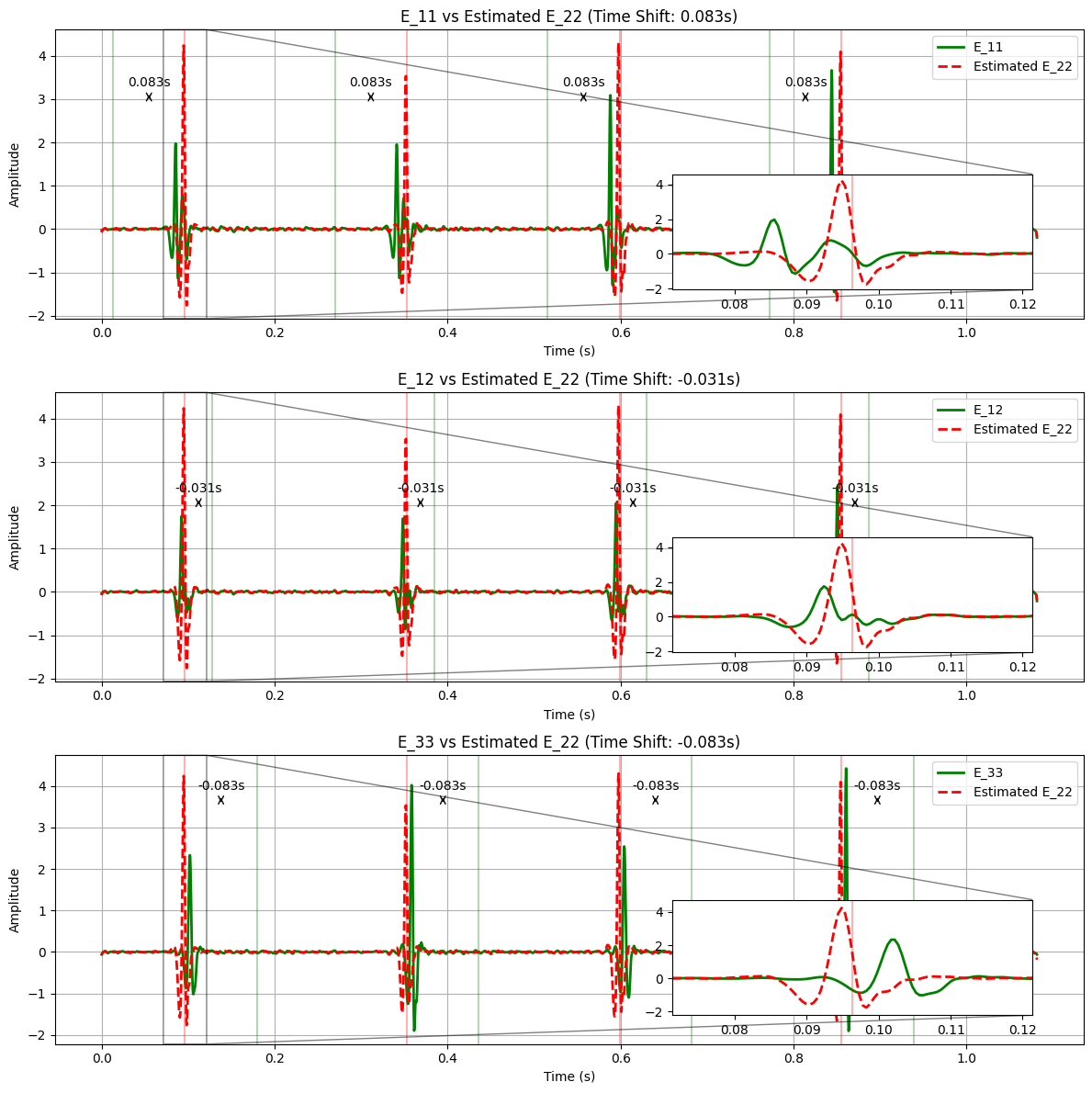
Results on sinus-rhythm data.
| Metric | Value |
|---|---|
| RMS localisation error | ~1.6 mm |
| End-to-end latency | ~78 ms |
| Channel cross-correlation | ≥ 0.99 |
Why it generalises. The transferable result is not the error bar; it is that imposing the governing equation as a soft constraint buys data efficiency and physical plausibility at the same time. That is exactly the trade you want in detector reconstruction, where labelled events are expensive and unphysical predictions are worse than imprecise ones.
This work formed my Masters thesis at Imperial, which was awarded the highest grade.
Status. Manuscript in preparation, targeting IEEE Transactions on Biomedical Engineering, benchmarking ATRIPINN against conventional numerical modelling of the same governing equations on 6×6 grid electrograms (Song et al., 2026).
Work in progress; outputs will appear here and on Publications.

Neutrino Physics @ Imperial College London, DUNE & NOvA Collab || Machine Learning || Quantum Computing || Quant Researcher || Multidisciplinary Scientist || Physics × ML × QC × Quant || 🇬🇧 London-based (2023–Present)
Imperial College London | Imperial College London
View profileReferences
2026
- In prep.Physics-Informed Neural Networks and Conventional Numerical Modelling for Real-Time Atrial Fibrillation Mapping from High-Density 6×6 Grid Electrograms: A Comparative StudyIEEE Transactions on Biomedical Engineering. Imperial College London, with clinical data from Hammersmith Hospital. , 2026Draft in preparation