Sagittarius A* variability
GRMHD and radiative transfer modelling of the Galactic Centre black hole.
UCL / Mullard Space Science Laboratory · 2023 – 2024 · with Dr Ziri Younsi and Prof Kinwah Wu
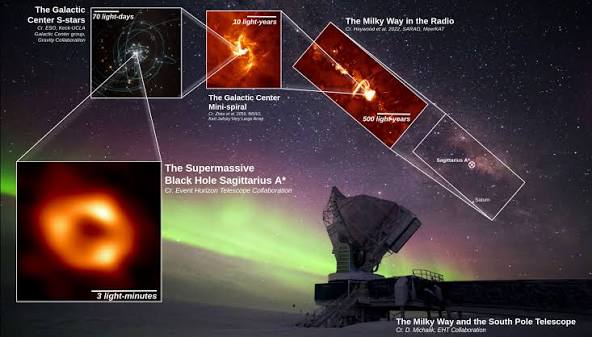
Sagittarius (Sgr) A* varies across the electromagnetic spectrum on timescales from minutes to hours. What that variability tells us about the accretion flow depends entirely on how the electrons are heated, and that is precisely the part of the physics that general-relativistic magnetohydrodynamics (GRMHD) does not determine on its own.
Method. GRMHD simulations run in BHAC, post-processed through general-relativistic radiative transfer in BHOSS, in Fortran and Python. This is high-performance computing (HPC) work throughout: both codes are MPI-parallelised and run on clusters rather than workstations, and a spin-and-heating parameter survey means dozens of long simulations, each producing time series large enough that the radiative post-processing is itself a substantial compute job. Managing that, from job submission and parallel scaling to the I/O and storage of the output, was a large part of the work.
Why the electrons need their own equation. The plasma is collisionless, so electrons and ions do not share a temperature, and it is the electrons that radiate. Taking moments of the Vlasov equation for each species gives particle-number conservation together with a stress-energy balance coupled to the electromagnetic field,
\[\nabla_\mu\!\left(\rho_k u^{\mu}_{k}\right) = 0, \qquad \nabla_\mu \tilde{T}^{\mu\nu}_{e} = -en\,u^{\mu}_{e}F_{\mu\nu}, \qquad \nabla_\mu \tilde{T}^{\mu\nu}_{i} = +en\,u^{\mu}_{i}F_{\mu\nu}\]and, after contracting with \(u_\nu\), a separate entropy equation for each species:
\[\rho T_e\,u^{\mu}\partial_\mu s_e = Q_e - \nabla_\mu q^{\mu}_{e} - a_\mu q^{\mu}_{e}, \qquad \rho T_i\,u^{\mu}\partial_\mu s_i = Q_i\]Everything contested sits in \(Q_e\): how much of the dissipated energy the electrons receive. GRMHD does not determine it, which is why the heating prescription has to be chosen and then tested against observation.
Parameter space. Magnetically arrested disc states across black hole spins \(a = -0.94\) to \(+0.94\), with three competing electron-heating prescriptions: R–\(\beta\), turbulent heating, and magnetic reconnection.
Status. Manuscript in preparation, targeting MNRAS, with co-authors including Dr Yosuke Mizuno and Dr Christian M. Fromm. Discussions with researchers from the EHT (Event Horizon Telescope) collaboration informed the radiative-transfer setup (Song et al., 2026).
Work in progress; outputs will appear here and on Publications.

Neutrino Physics @ Imperial College London, DUNE & NOvA Collab || Machine Learning || Quantum Computing || Quant Researcher || Multidisciplinary Scientist || Physics × ML × QC × Quant || 🇬🇧 London-based (2023–Present)
Imperial College London | Imperial College London
View profile