Modified Blandford–Znajek energy extraction
Reformulating how a rotating black hole gives up its energy, through the frame-dragged force-free magnetosphere.
In collaboration with the National Astronomical Observatory of Japan (NAOJ) · 2018 – 2024 · with Dr Isao Okamoto
A rotating black hole can lose energy without losing mass through the horizon. The Blandford–Znajek mechanism explains how: a magnetic field threading the hole, anchored in the surrounding plasma, carries electromagnetic energy outward along the spin axis. It is the leading candidate for powering relativistic jets. What it has never had is a fully satisfying account of where, physically, the energy is handed over.
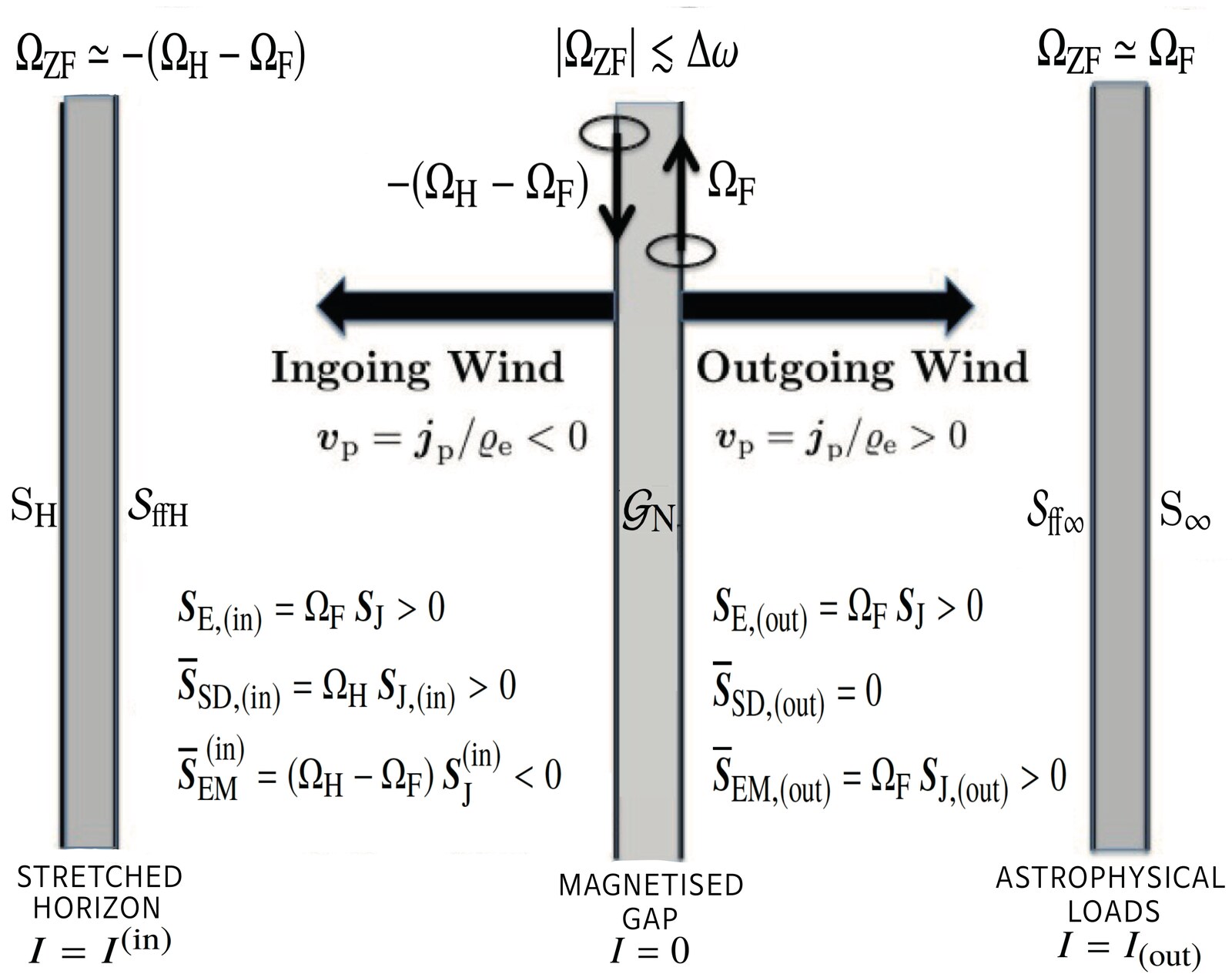
The reformulation. Working with Dr Isao Okamoto, we divided the force-free magnetosphere at the null surface, the boundary where the electric field magnitude equals the magnetic one in the zero-angular-momentum-observer (ZAMO) frame, and showed that electromagnetic energy is self-extracted across it. Cast this way, the process is not the black hole doing work on a distant load, but the frame-dragged magnetosphere transporting energy outward across a surface with a clear physical meaning (Okamoto & Song, 2023).
Where the null surface comes from. A ZAMO circulating with the frame-dragging angular velocity \(\omega\) does not measure the field-line angular velocity \(\Omega_F\) that a distant observer does, but
\[\Omega_{ZF} \;=\; \Omega_F - \omega\]so Ferraro’s law of isorotation fails in the ZAMO frame. The magnetosphere therefore splits at the surface \(S_N\) on which
\[\Omega_{ZF} = 0 \quad \Longleftrightarrow \quad \omega = \Omega_F \equiv \omega_N\]Outside \(S_N\) the domain spins forward and inside it spins backward, so the poloidal electric field reverses and the Poynting flux with it, while the angular-momentum flux continues outward throughout. Energy extraction survives that reversal only when \(\Omega_F < \Omega_H\), which the first and second laws of thermodynamics are what guarantee.
Extending it. A second paper carried the ZAMO treatment further, examining how the frame-dragging magnetosphere mediates the outward transport in Kerr spacetime (Okamoto et al., 2024).
What six years bought. The collaboration began in 2018 and ran across three countries. It was not continuous: I took a 19-month hiatus between 2018 and 2020 for my national service, and picked the work up again afterwards. The first preprint went through seven versions, and each one tightened the argument. Reformulating something the field already believes it understands is slower than adding a new result to it, and the case has to be built more carefully, because the burden of proof sits entirely with you. That is what the six years bought: an argument that holds.

Neutrino Physics @ Imperial College London, DUNE & NOvA Collab || Machine Learning || Quantum Computing || Quant Researcher || Multidisciplinary Scientist || Physics × ML × QC × Quant || 🇬🇧 London-based (2023–Present)
Imperial College London | Imperial College London
View profile