Gamma radiation from black hole magnetospheres
Lepton accelerators near the event horizon, and the very-high-energy emission they produce.
KASI & UST, and Academia Sinica · 2015 – 2018 · with Dr Kouichi Hirotani, Dr Satoki Matsushita, Dr Hung-Yi Pu and Prof Albert Kong
Pulsars have a well-developed theory of particle acceleration in vacuum gaps: regions where the plasma fails to screen the electric field along the magnetic field lines, so charged particles are accelerated to enormous energies and radiate. The question we asked is whether the same machinery operates around a black hole, which has no surface, no crust, and no rotating magnet, only spacetime.
It does, and frame dragging is why. Near a rapidly rotating black hole, frame dragging reverses the sign of the Goldreich–Julian charge density. That reversal leaves an unscreened magnetic-field-aligned electric field, which accelerates electrons and positrons in opposite directions and drives a pair cascade. The result is a lepton accelerator in the immediate vicinity of the event horizon (Song et al., 2017).
The particle accelerator (also known as the “gap”), written down. Under a stationary approximation, Gauss’s law gives a Poisson equation for the non-corotational potential \(\Psi\) in the three-dimensional magnetosphere,
\[-\frac{1}{\sqrt{-g}}\,\partial_\mu\!\left[\frac{\sqrt{-g}}{\rho_w^{2}}\,g^{\mu\nu}g_{\varphi\varphi}\,\partial_\nu\Psi\right] = 4\pi\left(\rho - \rho_{\mathrm{GJ}}\right)\]where the general-relativistic Goldreich–Julian charge density carries the frame-dragging frequency \(\omega \equiv -g_{t\varphi}/g_{\varphi\varphi}\) explicitly:
\[\rho_{\mathrm{GJ}} \equiv \frac{1}{4\pi\sqrt{-g}}\,\partial_\mu\!\left[\frac{\sqrt{-g}}{\rho_w^{2}}\,g^{\mu\nu}g_{\varphi\varphi}\left(\Omega_F - \omega\right)F_{\varphi\nu}\right]\]Wherever the real charge density \(\rho\) departs from \(\rho_{\mathrm{GJ}}\), an accelerating field \(E_\parallel = -\partial\Psi/\partial s\) appears along the field line. The gap is the region where \(E_\parallel \neq 0\), and it forms around the null-charge surface where \(\rho_{\mathrm{GJ}}\) changes sign, a surface that exists only because of frame dragging.
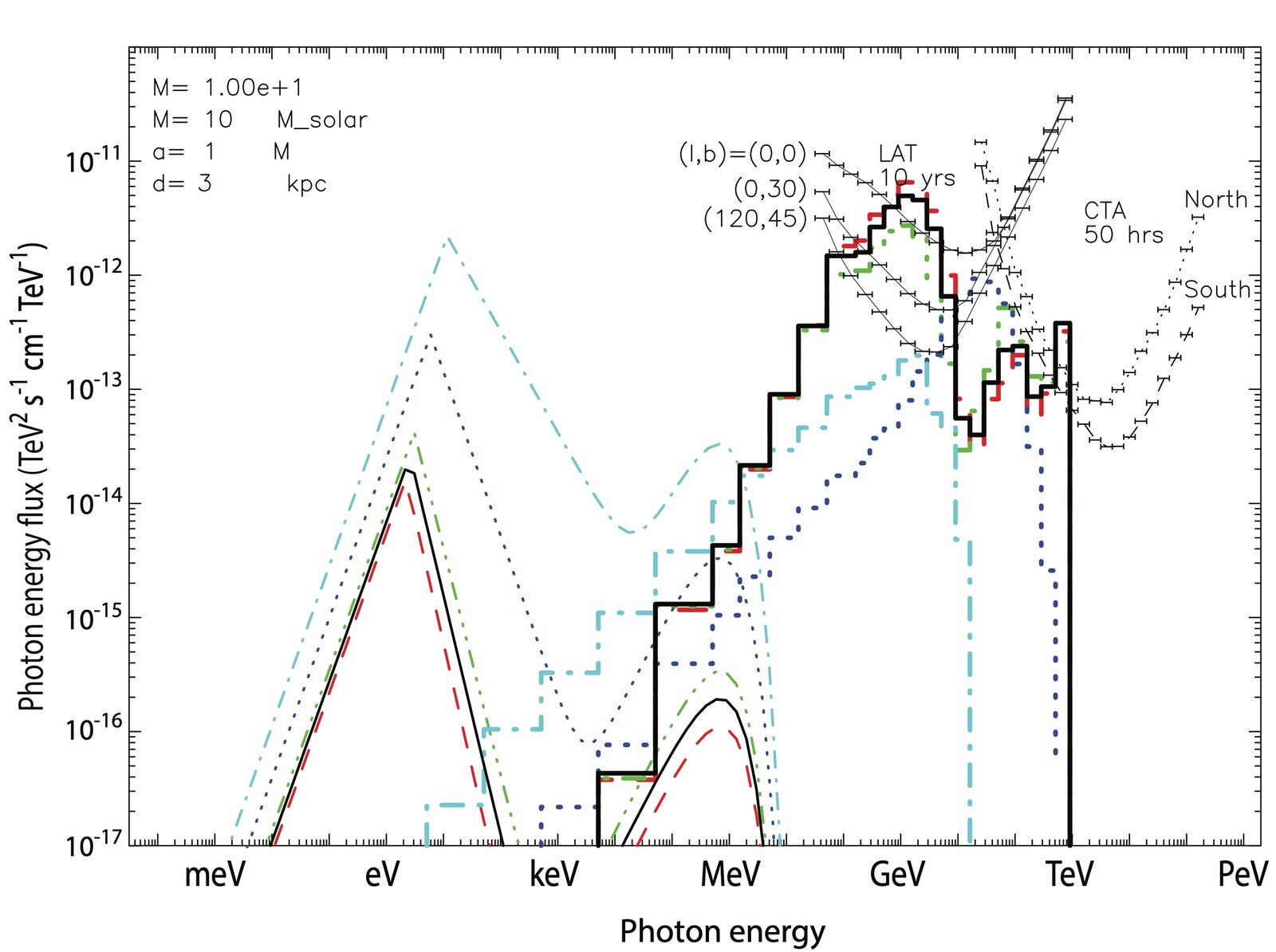
The observational prediction. The resulting gamma-ray flux is beamed towards the rotation axis, and it is strongly spin-dependent: it rises by more than an order of magnitude as the spin increases from \(a = 0.90M\) to \(a = 0.9999M\). That makes it a testable statement for Fermi-LAT and CTA, not merely a theoretical curiosity; a detection would constrain the spin of the emitting object.
Stellar-mass black holes too. Extending the same framework to a stellar-mass black hole traversing a dense gas cloud, we found that the pair cascade produces detectable very-high-energy emission if the hole is extremally rotating and within roughly 1 kpc (Hirotani et al., 2018).
This work ran across the Korea Astronomy and Space Science Institute and the University of Science and Technology, and a visiting studentship at the Academia Sinica Institute of Astronomy and Astrophysics in Taipei. The 2017 MNRAS paper was my first peer-reviewed first-author publication, at age 19.

Neutrino Physics @ Imperial College London, DUNE & NOvA Collab || Machine Learning || Quantum Computing || Quant Researcher || Multidisciplinary Scientist || Physics × ML × QC × Quant || 🇬🇧 London-based (2023–Present)
Imperial College London | Imperial College London
View profile